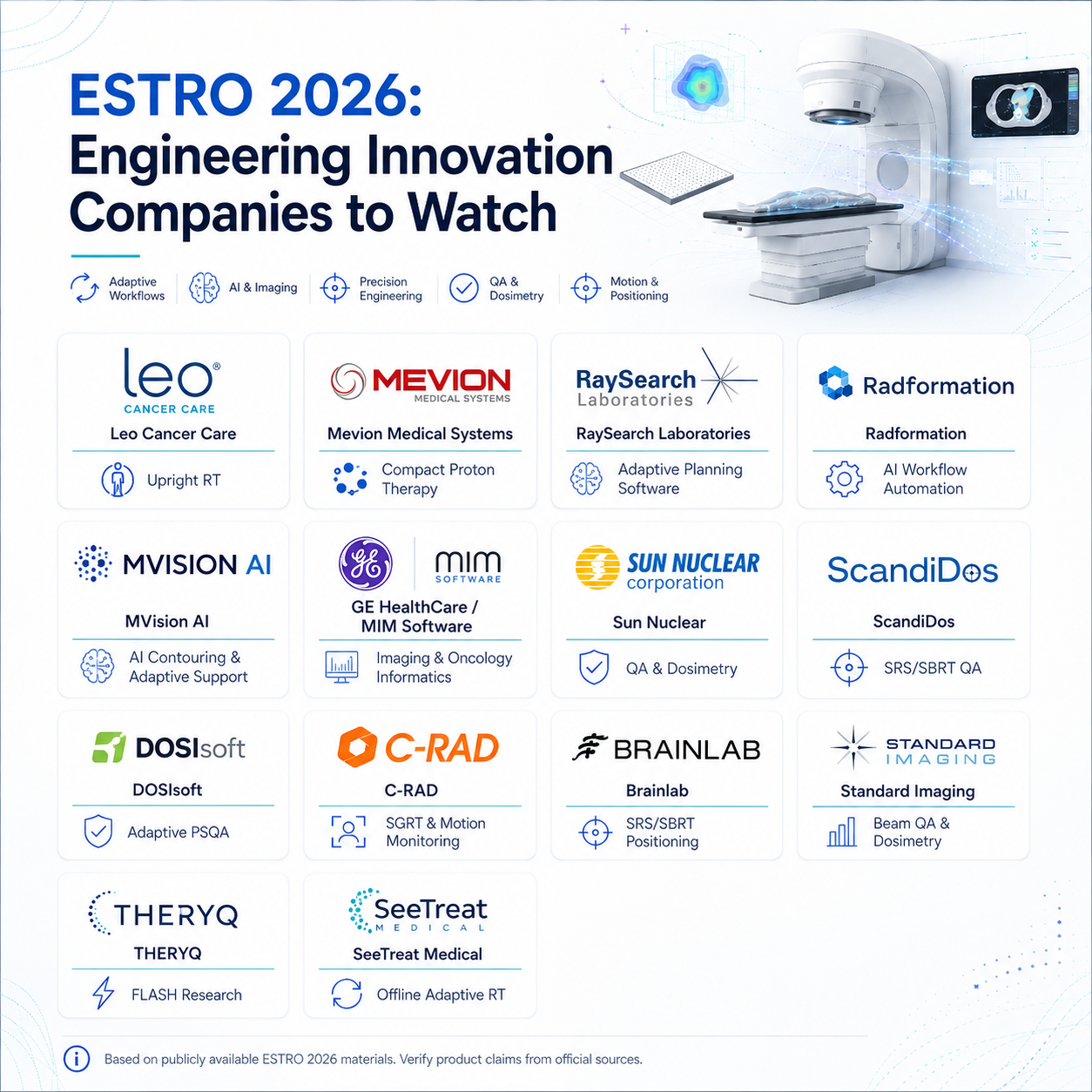
As ESTRO 2026 takes place in Stockholm, several companies are presenting technologies that could influence future cancer treatment workflows. From upright radiotherapy and compact proton therapy to AI-driven workflows, adaptive QA and surface guidance, these examples show how engineering continues to contribute to progress in radiotherapy.
As ESTRO 2026 continues, these selected examples are useful for understanding engineering-led innovation that could influence radiotherapy delivery, QA, imaging, automation and patient positioning in the coming years.
This is not a ranking, recommendation or procurement guide, and it is not a claim that every product is available in every market. It is a set of selected technical examples for biomedical engineers, radiotherapy engineers, medical physics learners and job seekers who want to understand where radiotherapy systems are moving.
The common theme is integration. Treatment rooms, imaging systems, treatment planning, oncology informatics, patient-specific QA, daily machine QA, surface guidance and AI workflow tools are becoming more connected. That creates new opportunities, but it also increases the need for careful validation, commissioning, training, cybersecurity and clinical governance.
How to read the innovation
For engineers and innovators, the most useful information at a congress is often not the headline claim. It is the change in system architecture, workflow timing, measurement chain, integration burden or clinical risk control that sits behind the product.
In this article, the companies are discussed one by one. Some examples sit close to treatment delivery, such as upright positioning and compact proton therapy. Others sit in the workflow layer, including adaptive planning, AI-supported contouring, daily machine QA, patient-specific QA and surface-guided positioning. Together, they show radiotherapy as a complete engineering ecosystem rather than a single treatment machine.
Selected companies and engineering themes
Leo Cancer Care
Upright radiotherapy and patient positioningLeo Cancer Care is presenting upright treatment setups at ESTRO 2026, including breast and pelvic positioning. The engineering interest is not only that the patient is upright; it is that imaging, immobilisation, patient rotation, treatment-room layout and workflow evidence all change when the patient rather than the gantry becomes the moving geometry.
The company is also connected with RaySearch activity around upright adaptive planning workflows. Grace should be described carefully as a future photon therapy concept under development; Leo states that Grace is not cleared or approved for sale. For engineers, the useful question is how upright simulation, adaptive planning and fixed-beam delivery could be validated as one controlled clinical workflow.

Mevion Medical Systems
Compact proton therapyMevion describes the MEVION S250-FIT as a proton therapy system designed for installation in a standard radiotherapy or LINAC vault. That wording matters: the article should not independently claim broad infrastructure savings or universal installation suitability. The safe interpretation is that Mevion is presenting an engineering approach intended to reduce the scale and complexity often associated with proton therapy facilities.
For radiotherapy engineers, the interesting part is the relationship between accelerator design, shielding, access, cooling, service space, vault integration and operational workflow. Compact proton therapy could influence how cancer centres think about proton access in the future, but any site-specific feasibility remains a matter for local planning, regulatory review and official vendor documentation.

RaySearch Laboratories
Treatment planning, oncology informatics and online adaptive radiotherapyRaySearch is showcasing RayStation and RayCare for adaptive workflow, including vendor-neutral online adaptive radiotherapy. Its ESTRO page also includes market-specific clearance language for online adaptive functionality, so availability and permitted clinical use should always be checked from official documentation.
The engineering significance is that treatment planning and oncology informatics are becoming more connected to delivery. Adaptive radiotherapy depends on image acquisition, registration, segmentation, dose calculation, plan approval, record-and-verify behaviour and treatment delivery working as a controlled sequence. RaySearch is therefore a useful example of software becoming part of the treatment delivery architecture, not simply a planning workstation.
Radformation
AI automation and adaptive workflow checksRadformation is presenting ChartCheck Adaptive and workflow automation for offline adaptive assessment. The company describes automation around adaptive assessment, in-vivo monitoring and daily treatment insight. In practice, this places the engineering focus on data flow, alerts, integration with clinical systems and the evidence trail behind automated checks.
For engineers, automation should not be understood only as time saving. A useful automation system has to make the right information visible at the right point in the workflow, with appropriate human review, traceable decisions and clear handling of exceptions. That is why adaptive workflow checks are an engineering safety topic as much as a software productivity topic.
MVision AI
AI contouring, imaging, dose prediction and adaptive supportMVision Workspace+ brings together contouring, synthetic imaging, dose prediction and offline adaptive support. The broader signal is that AI in radiotherapy is moving beyond single-task auto-contouring toward wider workflow support across imaging and planning processes.
That shift is important for biomedical and radiotherapy engineers because it increases the need for model validation, version control, data governance, integration testing and failure-mode thinking. AI-assisted workflow is only useful clinically when teams understand where it helps, where it needs review and how its output is documented.

GE HealthCare / MIM Software
Imaging, AI-supported workflow and RT softwareGE HealthCare is highlighting Intelligent Radiation Therapy and MIM software solutions at ESTRO 2026, including AI-supported workflow management and oncology software. The company frames these tools around connectivity, workflow coordination and support for complex oncology pathways.
The engineering story is interoperability. Modern radiotherapy involves CT simulation, image transfer, contouring, treatment planning, oncology information systems, QA systems and treatment delivery platforms. Any software layer that sits across that pathway has to deal with multi-vendor data, timing, user permissions, audit trails and clinical handover points.

Sun Nuclear
Machine QA, dosimetry and imaging/positioning QASun Nuclear is showing Daily QA 4 Pro and Plan AI. Daily QA 4 Pro is described as combining dosimetry and imaging/positioning checks in a single indexed device. That makes it relevant to everyday machine release workflows, where repeatable setup, efficient measurement and reliable documentation matter.
For engineers, daily QA innovation is not glamorous but it is foundational. A treatment unit is only useful when its output, geometry, imaging and safety systems remain within accepted tolerances. Tools that combine measurement streams may influence how departments collect evidence, trend machine behaviour and manage routine checks over time.

ScandiDos
Patient-specific QA for SRS and SBRTScandiDos is unveiling Delta4 SRS Pro, described in its press material as a stereotactic QA solution for high-precision 3D measurements at isocentre. The careful way to read this is as a product announcement in the patient-specific QA space, not as an independent performance endorsement.
The engineering relevance is clear: SRS and SBRT workflows involve small fields, steep dose gradients, non-coplanar arrangements and tight margins. Patient-specific QA for these techniques depends on detector geometry, spatial resolution, setup reproducibility and meaningful comparison between planned and measured dose.
DOSIsoft
Patient-specific QA and adaptive radiotherapy QADOSIsoft is showcasing ThinkQA 3.0 as a unified PSQA platform for offline and online adaptive radiotherapy. Its announcement describes GPU-powered 3D calculation and integrated QA workflows, while also noting that ThinkQA 3 is under ongoing product regulatory approval and may not be available in all markets.
That caution is important. Adaptive radiotherapy increases time pressure because the anatomy, plan and QA evidence may need to be reviewed close to treatment. The engineering challenge is to make secondary checks, logfile analysis, EPID workflows and adaptive plan verification faster without losing traceability or independent review.
SeeTreat Medical
Offline adaptive radiotherapy, CBCT-based dose reconstruction and same-day adaptive re-planningSeeTreat describes its ESTRO 2026 focus as the future of same-day adaptive re-planning. Its ART.1 software supports offline adaptive radiotherapy workflows, and the company also lists an ESTRO 2026 abstract on automated CBCT-based dose reconstruction in breast radiotherapy.
SeeTreat Medical is relevant because adaptive radiotherapy depends on reliable imaging, dose reconstruction, software integration and clinical decision support. For engineers, the important connection is between CBCT imaging, anatomical change assessment, dose reconstruction evidence and the workflow decision about whether a patient needs adaptive review or re-planning.
SeeTreat's page states that ART.1 is available for clinical use in the UK, EU and Australia, and that ART.1-US is FDA cleared for the US. Readers should verify current regulatory status from official SeeTreat documentation.

C-RAD
Surface-guided radiotherapy and patient monitoringC-RAD is focused on surface-guided radiotherapy and Catalyst+ HD workflow. SGRT is often discussed as patient positioning technology, but from an engineering point of view it is also an optical measurement system that interacts with room geometry, calibration routines, patient setup, gating behaviour and intra-fraction monitoring.
As treatment techniques become more precise, surface guidance can influence how teams think about setup accuracy and patient motion. The engineering work sits in commissioning, ongoing QA, camera calibration, software integration and understanding what the system can and cannot verify.

Brainlab
SRS/SBRT positioning, ExacTrac and intra-fraction monitoringBrainlab activity around ExacTrac Dynamic Surface and positioning/monitoring workflows sits in the high-precision stereotactic treatment space. These systems combine surface monitoring, patient positioning and, depending on configuration, image-guided verification concepts.
For engineers, the point is that stereotactic delivery depends on a chain of accuracy. Imaging, couch motion, surface information, beam hold logic, patient motion and QA checks all have to support the same clinical intent. Positioning technology should therefore be understood as part of the treatment safety architecture rather than a standalone accessory.
Standard Imaging
Daily beam QA and dosimetry devicesStandard Imaging is introducing QA BeamChecker Pro for routine beam QA. Daily and routine QA tools may not look as futuristic as adaptive radiotherapy or FLASH research, but they remain central to radiotherapy engineering because they provide evidence that treatment machines are performing consistently.
The engineering interest is in measurement stability, usability, data capture and trend review. Reliable routine QA helps teams detect drift, investigate faults and support controlled release to clinical use, which is why beam QA continues to be an important area of innovation.
THERYQ
FLASH radiotherapy and ultra-high dose-rate electron irradiationTHERYQ is focused on FLASH radiotherapy technology and the clinical translation of ultra-high dose-rate electron irradiation. This should be presented as a developing research and translation area, not as routine clinical treatment.
The engineering questions are demanding: accelerator design, ultra-high dose-rate beam monitoring, dosimetry, temporal control, QA standards and biological validation all need to mature together. FLASH is therefore a useful reminder that future cancer care is shaped not only by new machines, but by the measurement and safety systems that make new delivery methods testable.
Where the innovation is happening
Seen together, the selected examples cluster around several engineering directions. Leo Cancer Care is linked with upright positioning and room geometry. Mevion is focused on compact proton infrastructure. RaySearch, Radformation, DOSIsoft and SeeTreat Medical sit close to online and offline adaptive workflow. MVision AI, GE HealthCare/MIM, Radformation and SeeTreat Medical illustrate the shift toward AI, imaging and workflow support. Sun Nuclear, ScandiDos, Standard Imaging and DOSIsoft show continued innovation in QA and dosimetry. C-RAD and Brainlab highlight patient positioning and surface guidance, while THERYQ represents a developing FLASH research direction.
Why this matters for engineers
Radiotherapy is a complete engineering ecosystem. It includes accelerators, imaging systems, software, QA devices, patient positioning, automation, safety systems and clinical workflow design. ESTRO 2026 highlights how engineering innovation can influence cancer treatment far beyond the treatment machine itself.
For students and early-career engineers, this is also a useful career map. The future of radiotherapy is not only built by accelerator specialists. It also needs software engineers, clinical application specialists, QA physicists, service engineers, data engineers, image-processing specialists, cybersecurity-aware clinical technologists and people who can translate technical change into safe clinical workflow.
Verification note
This article is based on publicly available ESTRO 2026 company pages, official company announcements and press releases. Product availability, regulatory status and clinical claims should always be checked from the latest official company documentation before publication.
Useful Sources
- Leo Cancer Care at ESTRO 2026
- Leo Cancer Care Grace product status note
- Mevion S250-FIT ESTRO 2026 press release
- RaySearch at ESTRO 2026
- Radformation at ESTRO 2026
- MVision AI Workspace+
- GE HealthCare ESTRO 2026 announcement
- Sun Nuclear at ESTRO 2026
- ScandiDos Delta4 SRS Pro press release
- DOSIsoft ThinkQA 3.0 ESTRO 2026 announcement
- SeeTreat Medical at ESTRO 2026
- C-RAD Catalyst+ HD
- Brainlab ExacTrac Dynamic Surface
- Standard Imaging at ESTRO 2026
- THERYQ at ESTRO 2026
Publication disclaimer
This article is written in a personal educational capacity and is based on publicly available ESTRO 2026 company pages, official announcements and press releases. It does not represent the views of my employer, the NHS, ESTRO, or any company mentioned. Product availability, regulatory status and clinical claims should be verified from official company documentation.